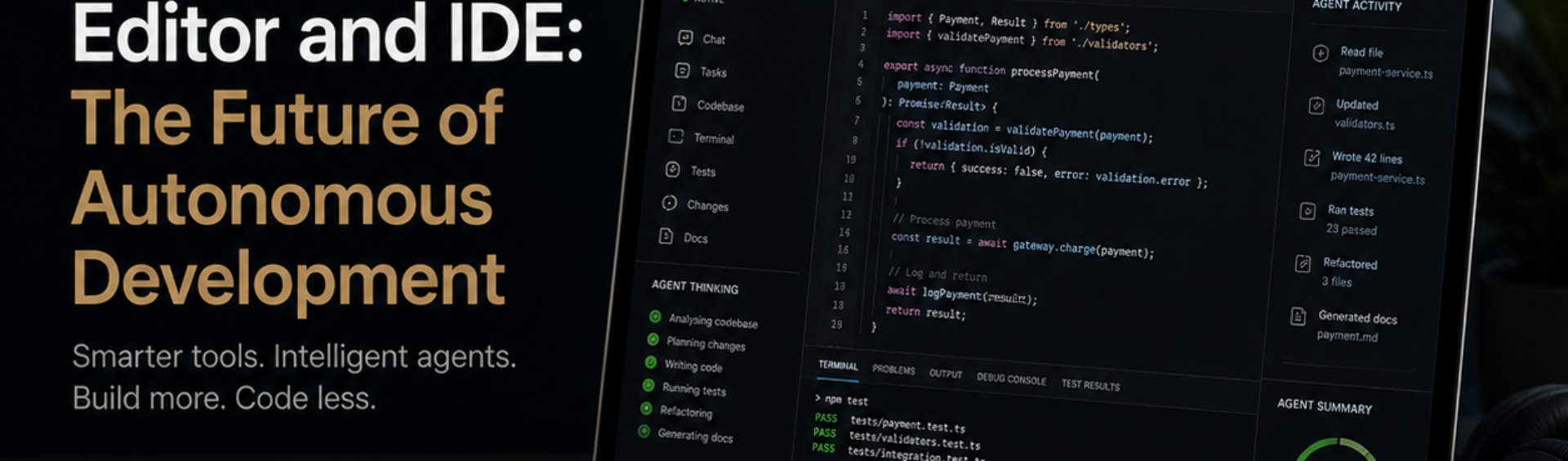
Software development is entering a new era.
For decades, developers have interacted with computers through code editors, terminals, and increasingly sophisticated IDEs. While tools became more powerful, the relationship remained largely unchanged. Humans wrote instructions. Computers executed them.
Artificial intelligence is fundamentally altering that dynamic.
A new generation of AI-powered development environments is emerging, transforming editors into intelligent collaborators capable of understanding goals, planning tasks, modifying codebases, conducting research, and executing complex workflows with minimal supervision.
The age of the AI Agent Editor has arrived.
Beyond Autocomplete
The first wave of AI development tools focused primarily on assistance.
They completed lines of code.
Suggested functions.
Generated snippets.
Answered technical questions.
While useful, these systems remained reactive.
The developer still performed the majority of planning, navigation, implementation, testing, and decision-making.
Agent-based systems represent a significant leap forward.
Rather than helping write code, they help build solutions.
Instead of asking:
“How do I create this feature?”
Developers increasingly ask:
“Build this feature and explain your decisions.”
The difference is profound.
What Is an AI Agent Editor?
An AI Agent Editor combines traditional development tools with autonomous AI capabilities.
The editor can:
- Understand project objectives
- Analyse existing codebases
- Generate implementation plans
- Create and modify files
- Run tests
- Debug issues
- Refactor architecture
- Create documentation
- Coordinate multiple tasks simultaneously
The developer becomes less of a typist and more of a director.
The focus shifts from implementation to intent.
Google’s Vision: Project Astra, Gemini and Agentic Development
Major technology companies are investing heavily in agent-based workflows.
Google’s recent demonstrations of increasingly autonomous AI systems showcase a future where models move beyond simple conversations and actively perform tasks across applications, tools, and workflows.
Projects such as Gemini-powered development environments and experimental concepts often referred to by the community as “agentic IDEs” demonstrate a future where AI systems can reason across an entire project rather than responding to isolated prompts.
The objective is not simply generating code.
It is understanding goals and executing toward them.
This shift mirrors the evolution from calculators to computers.
The tool no longer performs a single operation.
It becomes a platform for intelligent action.
The New Generation of AI Development Environments
Several platforms are helping define this emerging category.
Claude Code
Claude Code has demonstrated how conversational AI can directly interact with development environments.
Developers can delegate tasks, analyse repositories, perform refactoring, and coordinate complex implementations through natural language.
Cursor
Cursor has rapidly become one of the most recognised AI-first development environments.
By integrating AI deeply into the coding workflow, it enables developers to work collaboratively with intelligent systems capable of understanding project context.
Windsurf
Windsurf focuses on creating an integrated experience where AI actively participates throughout the software lifecycle rather than acting as a separate assistant.
Continue
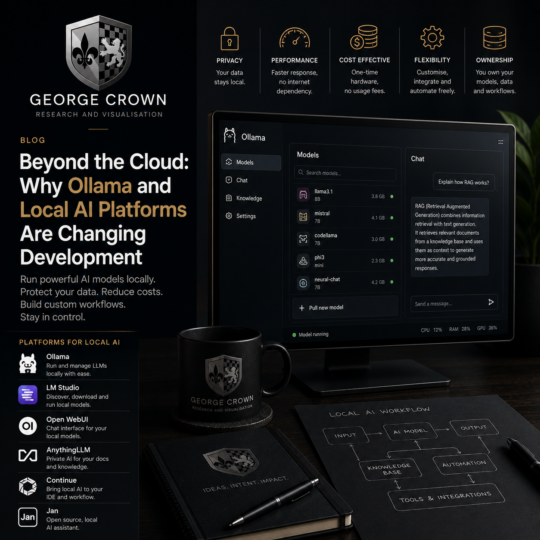
Continue allows developers to connect local and cloud-based models directly to their preferred editors, creating customised AI workflows tailored to specific requirements.
Local Agent Ecosystems
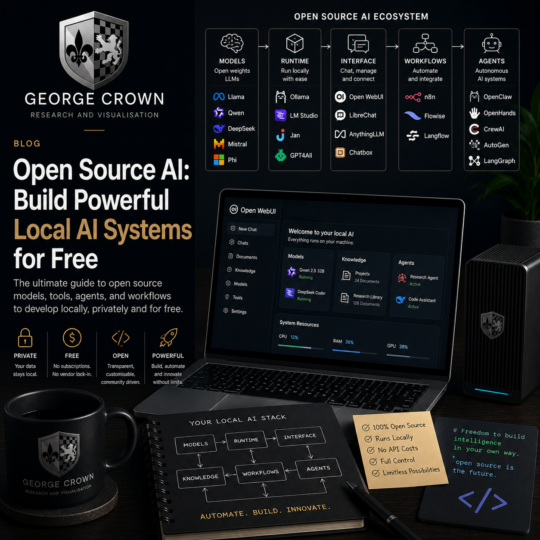
Open-source communities are rapidly developing self-hosted alternatives that combine:
- Local language models
- Coding agents
- Workflow automation
- Research systems
- Knowledge databases
These solutions provide greater privacy, control, and customisation while maintaining many of the benefits of cloud-based platforms.
Why This Matters
The impact extends far beyond productivity.
AI agent editors are changing how software is conceived.
Projects that once required teams can increasingly be explored by individuals.
Ideas move from concept to prototype faster than ever before.
Technical barriers become lower.
Experimentation becomes cheaper.
Innovation becomes more accessible.
The bottleneck shifts away from implementation and toward clarity of thought.
The most valuable skill becomes defining the right problem.
Research Driven Development
One of the most powerful capabilities of agent-based systems is research integration.
Modern development often requires understanding:
- Framework documentation
- APIs
- Industry standards
- Security requirements
- User needs
- Competitive solutions
AI agents can continuously gather, analyse, and organise information while development progresses.
This creates a workflow where research and implementation happen simultaneously.
The result is better informed decision-making and more robust outcomes.
From Coding to Orchestration
The role of the developer is evolving.
Traditional development focused heavily on implementation.
Future development will increasingly focus on orchestration.
Developers will:
- Define objectives
- Design workflows
- Evaluate outputs
- Guide architecture
- Validate decisions
- Manage intelligent systems
The skill set becomes closer to directing a team than manually constructing every component.
The ability to communicate intent clearly becomes just as important as technical expertise.
The Importance of Human Oversight
Despite their capabilities, AI agents are not replacements for human judgement.
They can generate solutions.
They cannot fully understand business priorities.
They can write code.
They cannot own responsibility.
They can optimise processes.
They cannot define purpose.
Successful teams will combine human insight with machine execution.
The most effective workflows place humans in strategic roles while delegating repetitive and time-consuming tasks to AI systems.
Looking Ahead
The future IDE may look very different from today’s development environments.
Instead of dozens of tabs and terminals, developers may interact with intelligent systems that:
- Research requirements
- Design solutions
- Build implementations
- Test functionality
- Generate documentation
- Monitor deployments
All while keeping humans informed and in control.
Development becomes less about writing every line and more about directing intelligent systems toward meaningful outcomes.
Final Thoughts
AI agent editors represent one of the most significant shifts in software development since the introduction of modern IDEs.
They transform software creation from a process of manual implementation into a process of intelligent collaboration.
The future developer will not work alone.
They will work alongside a team of specialised digital agents capable of researching, building, testing, documenting, and refining ideas at unprecedented speed.
The question is no longer whether AI will become part of the development process.
The question is how effectively we learn to collaborate with it.
The future of coding is not just artificial intelligence.
It is intelligent orchestration.