The way software is created is changing.
For decades, development has been a process of translating ideas into increasingly precise technical instructions. Designers create wireframes, architects define systems, developers write code, and eventually a product emerges.
Artificial intelligence is reshaping that workflow.
A new approach has emerged within the development community known as vibe coding. While the name sounds informal, the concept represents a significant shift in how humans interact with technology.
Rather than focusing solely on writing code line by line, developers increasingly work by communicating intent, vision, and desired outcomes to AI systems capable of generating and refining the implementation.
The emphasis moves from syntax to strategy.
What Is Vibe Coding?
Vibe coding is the practice of guiding software creation through high-level intent rather than detailed instructions.
Instead of saying:
“Create a React component using TypeScript with state management and API integration.”
You might say:
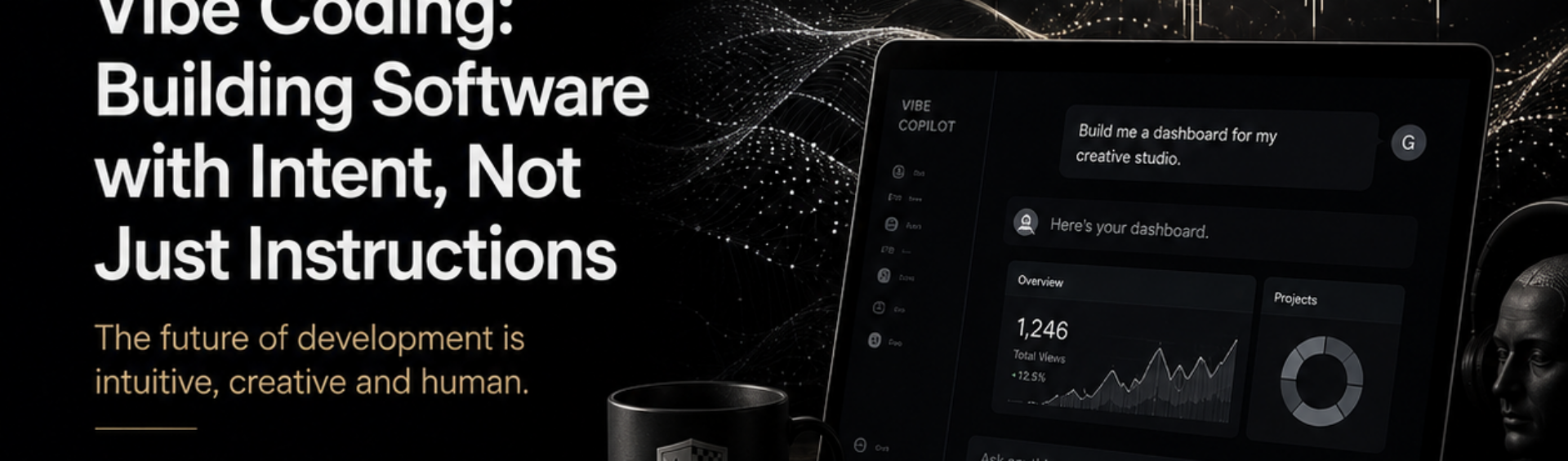
“I need a dashboard that helps creative professionals track projects, understand performance, and quickly identify opportunities.”
The AI interprets the objective and generates the foundation.
The developer then refines, validates, improves, and directs the result.
The process becomes less about typing code and more about shaping outcomes.
The Architect’s Approach to Software
In many ways, vibe coding mirrors architecture.
Architects do not begin by calculating every bolt, screw, and material connection. They begin by understanding purpose.
Who will use the space?
How should it feel?
What problems does it solve?
What experience should it create?
Only after the vision becomes clear does the technical detail emerge.
Software development is moving in a similar direction.
The most valuable skill is increasingly not the ability to write every line of code manually, but the ability to clearly define objectives, evaluate solutions, and guide systems toward meaningful outcomes.
Research Becomes More Important
A common misconception is that AI reduces the need for expertise.
The opposite is often true.
When implementation becomes faster, decision-making becomes more valuable.
Successful projects require:
- Better research
- Stronger planning
- Clearer objectives
- Better understanding of users
- Stronger validation processes
An AI can generate thousands of lines of code in seconds.
It cannot automatically determine whether the solution is the right one.
That responsibility still belongs to the human directing the process.
Visualisation Drives Better Results
One of the most powerful aspects of modern AI-assisted development is the ability to visualise ideas rapidly.
Concepts that once required weeks of design and development can now be explored in hours.
Interfaces can be prototyped.
Workflows can be tested.
Experiences can be refined before significant resources are committed.
Visualisation allows teams to explore possibilities, identify weaknesses, and improve solutions before implementation reaches production.
This is where technology becomes most valuable, not replacing creativity, but accelerating it.
The Rise of Creative Technologists
The boundaries between disciplines are becoming increasingly blurred.
Today’s creators often combine:
- Design thinking
- Technical knowledge
- Research methodologies
- Visual communication
- Artificial intelligence
The future belongs to professionals who can move comfortably between these worlds.
People who understand both the vision and the implementation.
People who can research, visualise, test, and build.
Beyond Coding
Vibe coding is not really about coding.
It is about communication.
It is about transforming ideas into reality with greater speed and flexibility than ever before.
The keyboard is becoming less important than the conversation.
The prompt is becoming as important as the program.
And the ability to clearly articulate intent may become one of the most valuable skills of the next decade.
Final Thoughts
Artificial intelligence is changing how we create software, but the fundamentals remain the same.
Good solutions still require research.
Great products still require vision.
Successful projects still require human judgement.
Technology can generate code.
Humans generate purpose.
The future of development will not belong to those who simply write instructions.
It will belong to those who can clearly define what should be built, why it matters, and how it should improve the human experience.
That is the real essence of vibe coding.