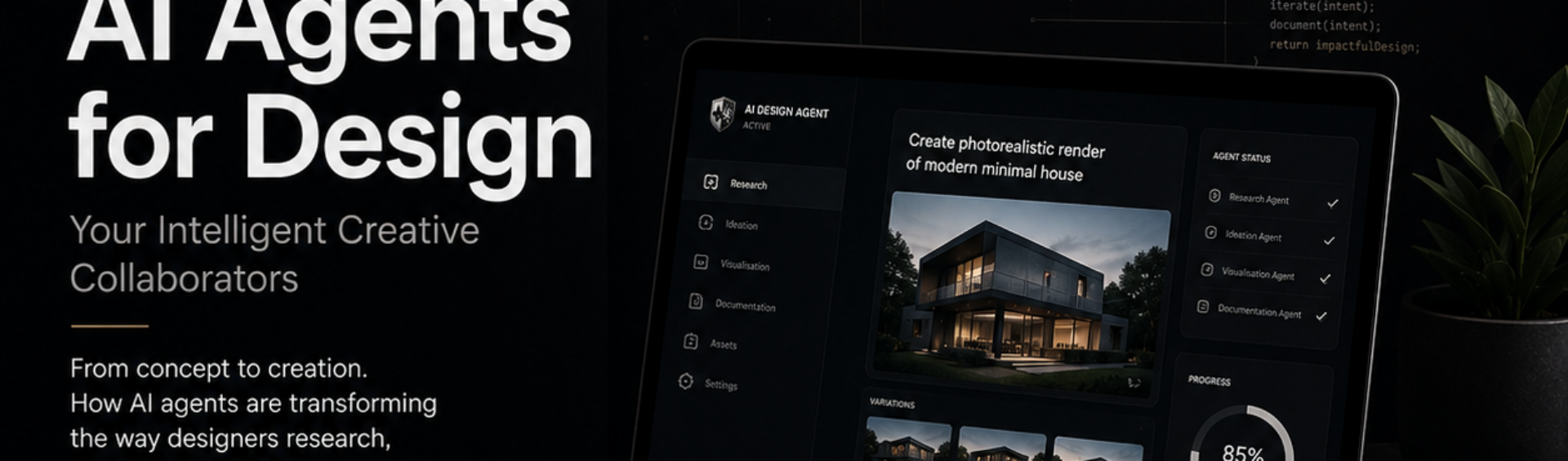
Artificial intelligence is rapidly evolving from a tool into something far more capable.
For years, designers have used software to draw, model, render, document, and present ideas. The software itself remained passive. It waited for instructions.
Today, a new generation of AI systems is changing that relationship.
AI agents are emerging as active collaborators capable of researching information, generating concepts, refining designs, creating visualisations, and even managing project workflows.
Rather than replacing designers, these agents are becoming powerful extensions of the creative process.
What Are AI Agents?
Unlike traditional AI tools that perform a single task, AI agents can operate with objectives.
They can:
- Research information
- Analyse requirements
- Generate ideas
- Create visual assets
- Evaluate solutions
- Coordinate workflows
- Produce documentation
- Iterate based on feedback
An AI agent acts less like software and more like a specialist assistant working toward a defined goal.
Imagine assigning a brief to a digital team member that can continuously gather information, develop options, and present recommendations while you focus on higher-level decisions.
That is the promise of AI agents.
From Tools to Teams
Design workflows have traditionally required multiple disciplines working together.
Researchers gather information.
Designers explore concepts.
Visualisers create presentations.
Technical specialists develop documentation.
Project managers coordinate delivery.
AI agents can now assist at each stage.
A single design project might involve:
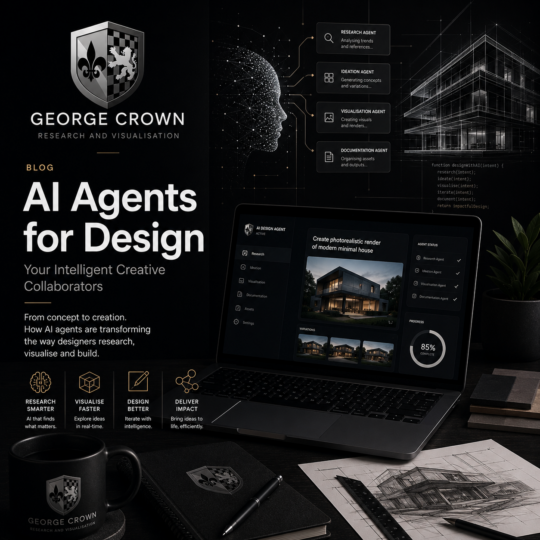
Research Agent
Collecting precedent studies, regulations, market insights, user requirements, and emerging trends.
Concept Agent
Generating ideas, exploring alternatives, and identifying creative opportunities.
Visualisation Agent
Producing sketches, renders, animations, diagrams, and presentations.
Documentation Agent
Organising files, specifications, reports, schedules, and project information.
Each agent performs a focused role while contributing to a larger objective.
Why This Matters for Designers
The most valuable resource in any creative project is time.
Many professionals spend countless hours performing repetitive tasks that support design but do not directly contribute to innovation.
AI agents can dramatically reduce that workload.
Instead of spending hours gathering reference material, a research agent can produce structured findings in minutes.
Instead of manually creating dozens of concept variations, an ideation agent can explore possibilities almost instantly.
Instead of spending days preparing presentations, visualisation agents can generate high-quality outputs on demand.
The result is more time available for critical thinking, creativity, and decision-making.
Research Becomes Continuous
One of the most significant advantages of AI agents is their ability to continuously monitor information.
Design is influenced by:
- Technology
- Culture
- Economics
- Regulations
- Sustainability
- User behaviour
These factors constantly evolve.
An AI research agent can track developments in real time, helping designers make more informed decisions throughout a project’s lifecycle.
The designer gains access to a constantly updated knowledge base rather than relying solely on periodic research phases.
Visualisation at the Speed of Thought
Perhaps the most transformative impact is in visualisation.
Ideas that once required days or weeks to communicate can now be explored almost immediately.
Designers can move seamlessly between:
- Written concepts
- Sketches
- Diagrams
- 3D models
- Photorealistic renders
- Interactive experiences
The distance between imagination and communication continues to shrink.
This allows teams to test ideas earlier, identify weaknesses faster, and make better decisions before resources are committed.
The Human Role Becomes More Important
There is a misconception that AI agents will eventually remove the need for designers.
The reality appears to be the opposite.
As AI becomes more capable, human judgement becomes more valuable.
AI can generate possibilities.
Humans define purpose.
AI can produce options.
Humans decide which option matters.
AI can accelerate execution.
Humans provide vision.
The most successful professionals will not be those who compete against AI agents, but those who learn to direct them effectively.
Designing the Future
Architecture, technology, and design have always shared a common goal: transforming ideas into reality.
AI agents represent the next evolution of that process.
They allow us to explore more possibilities, process more information, and visualise more effectively than ever before.
The future of design will not be defined by humans or artificial intelligence alone.
It will be defined by collaboration between the two.
The designer becomes the strategist.
The AI agent becomes the accelerator.
Together, they create outcomes neither could achieve independently.
Final Thoughts
We are entering an era where every designer may have access to an entire team of digital specialists working alongside them.
Research agents.
Visualisation agents.
Documentation agents.
Creative agents.
The question is no longer whether AI will influence design.
The question is how effectively we can integrate these new collaborators into our creative process.
Those who embrace this shift will gain the ability to move faster, think bigger, and transform ideas into reality with unprecedented speed and clarity.
The future of design is not artificial.
It is amplified.