Artificial intelligence is evolving rapidly.
The conversation is no longer focused solely on chatbots, image generation, or code completion.
The next frontier is AI agents.
These systems are designed not just to answer questions, but to take action.
They can observe environments, make decisions, use tools, complete tasks, coordinate workflows, and interact with digital systems on behalf of users.
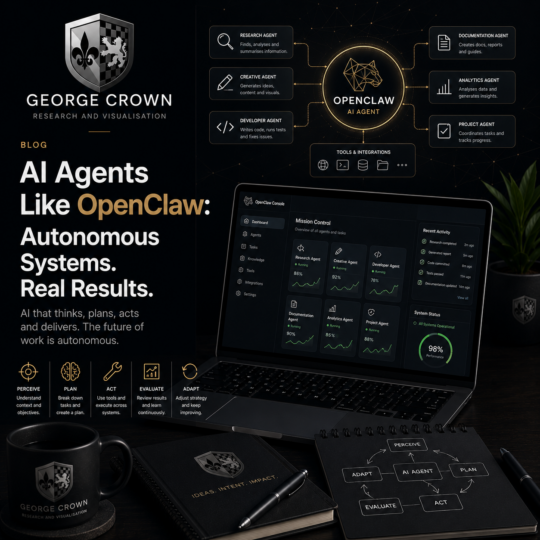
Projects such as OpenClaw and a growing ecosystem of autonomous agent frameworks are demonstrating what happens when AI moves beyond conversation and begins operating within the real world.
The result is a fundamental shift in how we think about software.
What Is an AI Agent?
A traditional AI model responds to prompts.
An AI agent pursues objectives.
Rather than generating a single answer, an agent can:
- Analyse a task
- Create a plan
- Execute actions
- Evaluate results
- Adapt strategy
- Continue working until a goal is achieved
The difference may seem subtle, but it changes everything.
A chatbot answers questions.
An agent solves problems.
From Assistants to Operators
Most people interact with AI as an assistant.
You ask a question.
The system responds.
The interaction ends.
AI agents extend the process.
Instead of asking:
“How do I build a website?”
You might ask:
“Build the first version of my website, research competitors, generate content, and prepare deployment documentation.”
The agent can then coordinate multiple tools and workflows to achieve the objective.
The focus shifts from conversation to execution.
The OpenClaw Approach
OpenClaw and similar open-source projects represent an important step toward autonomous digital workforces.
These systems combine:
- Large language models
- Planning systems
- Tool integrations
- Memory systems
- Workflow automation
- Browser control
- File management
- External applications
The objective is not merely generating responses.
It is completing tasks.
An agent might:
- Search the web
- Read documentation
- Create files
- Generate reports
- Update databases
- Modify code
- Manage workflows
All while maintaining awareness of a broader objective.
Why Agents Matter
Artificial intelligence becomes significantly more valuable when it can interact with systems rather than simply describe them.
Consider a design project.
A traditional AI may help generate ideas.
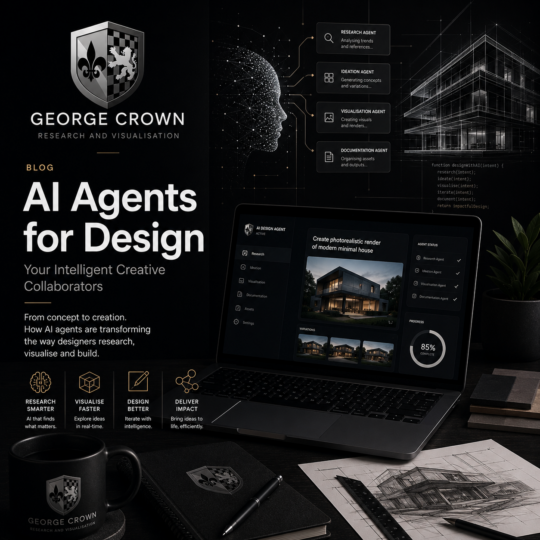
An agent-based system can:
- Gather research
- Analyse references
- Create visualisations
- Organise assets
- Generate documentation
- Track project progress
The agent becomes part of the workflow itself.
This dramatically increases productivity while reducing repetitive work.
The Building Blocks of an Agent
Most modern AI agents share several common components.
Reasoning
The ability to understand objectives and determine appropriate actions.
Memory
The ability to retain context across multiple tasks and sessions.
Tools
Access to applications, APIs, browsers, databases, and software systems.
Planning
Breaking large objectives into smaller executable tasks.
Feedback Loops
Evaluating results and adjusting behaviour when necessary.
Together, these components transform a model into an operational system.
Multi-Agent Systems
One of the most exciting developments is the rise of multi-agent architectures.
Instead of a single AI performing every task, multiple specialised agents collaborate.
For example:
Research Agent
Collects and organises information.
Design Agent
Creates concepts, visuals, and presentations.
Development Agent
Builds software and manages code.
Documentation Agent
Generates reports and project records.
Project Manager Agent
Coordinates workflows and monitors progress.
Each agent focuses on its strengths while contributing to a shared objective.
This mirrors how human teams operate.
AI Agents for Research and Visualisation
At George Crown, research and visualisation form the foundation of effective decision-making.
AI agents are particularly powerful in these areas.
Research agents can analyse enormous volumes of information in minutes.
Visualisation agents can transform ideas into diagrams, renders, prototypes, and presentations.
Together, they create an environment where information becomes insight and insight becomes action.
Rather than spending days gathering data or preparing assets, teams can focus on interpreting results and making strategic decisions.
Local Agents vs Cloud Agents
As agent technology evolves, two distinct approaches are emerging.
Cloud-Based Agents
Operate through external AI providers.
Advantages include:
- Large-scale processing
- Simplicity
- Access to cutting-edge models
Local Agents
Operate on self-hosted infrastructure.
Advantages include:
- Privacy
- Data ownership
- Customisation
- Lower long-term costs
- Greater control
Many organisations are increasingly adopting hybrid approaches that combine the strengths of both.
Challenges Ahead
Despite their potential, AI agents are still developing.
Current limitations include:
- Reliability
- Tool compatibility
- Long-term planning
- Context management
- Security concerns
- Human oversight requirements
The technology is improving rapidly, but fully autonomous systems remain a work in progress.
Successful deployment still requires careful design and human supervision.
The Future Digital Workforce
The long-term vision is compelling.
Imagine every organisation having access to teams of specialised digital workers capable of:
- Conducting research
- Analysing data
- Creating content
- Building software
- Managing projects
- Producing visualisations
- Monitoring operations
These agents operate continuously, scale instantly, and collaborate across systems.
The result is not simply automation.
It is a new form of workforce augmentation.
Final Thoughts
AI agents represent one of the most important developments in artificial intelligence since the introduction of large language models.
Projects such as OpenClaw are helping demonstrate what becomes possible when AI moves beyond conversation and begins taking action.
The future is unlikely to be defined by isolated models responding to prompts.
Instead, it will be shaped by intelligent agents capable of researching, planning, executing, and collaborating across entire workflows.
The organisations that learn to design and orchestrate these systems effectively will gain a significant advantage.
The future of AI is not just intelligence.
It is an agency.