Artificial intelligence has become one of the most powerful tools available to developers, researchers, designers, and creators.
Most AI services today operate through the cloud.
You send a prompt.
A remote server processes the request.
A response returns seconds later.
The experience is convenient, but it comes with limitations.
Privacy concerns, subscription costs, internet dependency, API restrictions, and limited customisation have led many professionals to explore a different approach.
Running AI locally.
Platforms such as Ollama and other self-hosted AI ecosystems are making it easier than ever to build powerful AI-powered workflows directly on personal hardware.
The result is a growing movement toward local-first artificial intelligence.
What Is Ollama?
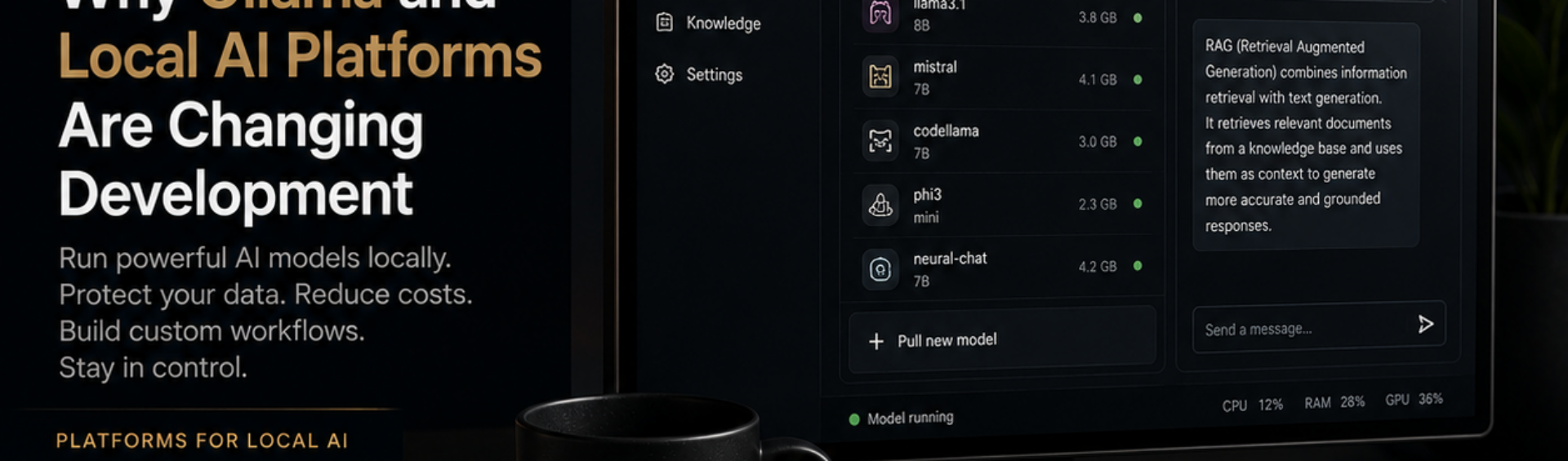
Ollama is a lightweight platform that allows users to download, run, and manage large language models directly on their own machines.
Instead of connecting to a cloud service, models run locally on:
- Windows
- macOS
- Linux
- Workstations
- Home servers
- Development machines
The experience is surprisingly simple.
A single command can download and launch a powerful language model capable of coding, writing, analysis, reasoning, and problem solving.
For developers, Ollama has become one of the most accessible entry points into local AI.
Why Developers Are Moving Local
Cloud-based AI platforms remain incredibly useful, but local deployment offers several advantages.
Privacy and Security
Sensitive information never leaves your environment.
This is particularly important when working with:
- Client data
- Source code
- Research projects
- Internal documentation
- Intellectual property
Local processing provides greater confidence and control over how information is handled.
Lower Long-Term Costs
Cloud services often charge based on usage.
As AI becomes integrated into daily workflows, these costs can increase significantly.
Local models require hardware investment, but ongoing usage becomes effectively unlimited.
Faster Iteration
For many tasks, local systems eliminate network latency and external dependencies.
Developers can experiment freely without worrying about API limits or usage quotas.
Full Control
Local AI environments can be customised extensively.
Models can be swapped, upgraded, fine-tuned, automated, and integrated into bespoke workflows.
The user controls the system rather than adapting to someone else’s platform.
Beyond Ollama
While Ollama has become one of the most popular solutions, it represents only part of a rapidly growing ecosystem.
Several platforms are helping shape the future of local AI development.
LM Studio
LM Studio provides a user-friendly interface for downloading and running local language models.
Its visual approach makes local AI accessible to non-technical users while still providing powerful capabilities.
Open WebUI
Open WebUI delivers a polished ChatGPT-style interface for local models.
It allows teams and individuals to interact with self-hosted AI systems through a familiar conversational experience.
AnythingLLM
AnythingLLM focuses on building private knowledge systems.
Users can connect documents, research materials, and databases to create AI assistants capable of answering questions using their own information.
Continue
Continue brings local AI directly into development environments.
Developers can connect self-hosted models to editors such as Visual Studio Code and create highly customised coding workflows.
Jan
Jan is an open-source desktop AI assistant designed to provide local-first AI experiences with an emphasis on privacy and ownership.
Building AI Workflows
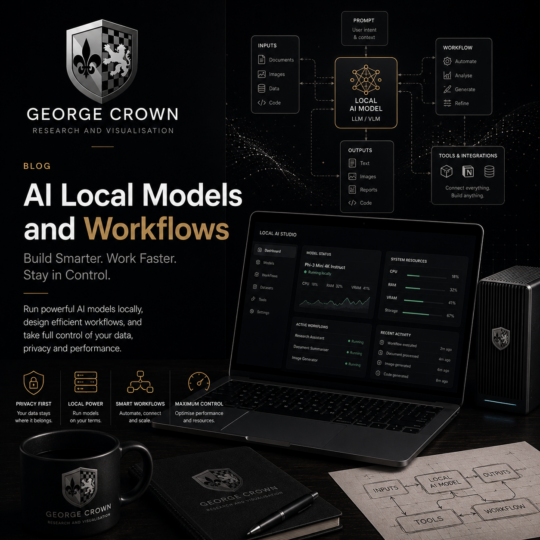
Running a local model is only the first step.
The real opportunity lies in creating workflows.
Imagine a development system where:
- A coding model writes software
- A research agent gathers documentation
- A testing agent validates functionality
- A documentation agent creates reports
- A knowledge system stores project information
Each component works together as part of a larger process.
Instead of interacting with a single chatbot, developers create intelligent systems capable of handling complex tasks.
The Local AI Stack
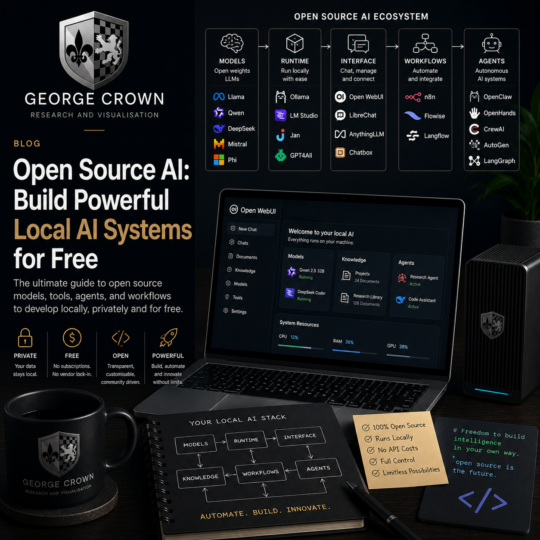
A modern local AI setup often includes:
Models
Language models, coding models, vision models, and multimodal systems.
Interfaces
Applications such as Open WebUI, LM Studio, and desktop assistants.
Knowledge Systems
Vector databases and document retrieval tools that provide context.
Automation Platforms
Workflow tools that connect models, applications, and data sources.
Development Tools
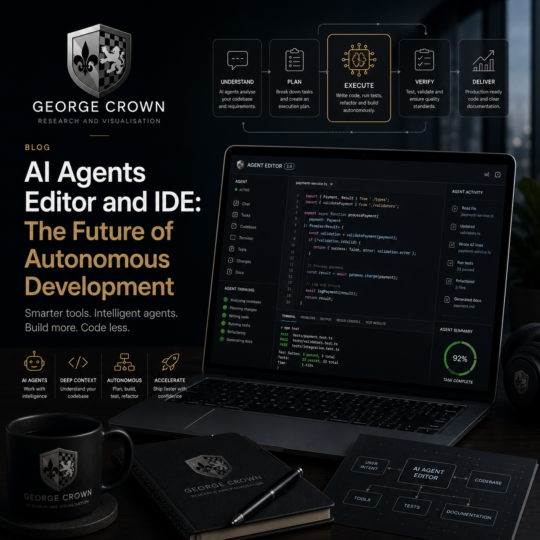
AI-enabled editors and agent-based coding environments.
Together they form a complete AI ecosystem operating entirely under the user’s control.
Research and Visualisation
At George Crown, research and visualisation are central to the creative process.
Local AI platforms support both disciplines exceptionally well.
Research workflows can process large volumes of information, identify patterns, and organise knowledge efficiently.
Visualisation workflows can generate concepts, explore alternatives, and communicate ideas more effectively.
By combining research systems with local models and intelligent workflows, creators gain the ability to move from information to insight and from insight to action with remarkable speed.
Challenges to Consider
Local AI is powerful, but it is not magic.
Successful deployment requires consideration of:
- Hardware resources
- GPU availability
- Storage requirements
- Model selection
- Workflow design
- Maintenance
The strongest systems balance capability with practicality.
The objective is not necessarily to replace cloud services entirely, but to use local AI where it provides the greatest benefit.
The Future of Personal AI Infrastructure
The next generation of AI users will not simply consume AI services.
They will build AI infrastructure.
Personal models.
Private knowledge bases.
Custom agents.
Automated workflows.
Intelligent development environments.
What was once available only to large technology companies is increasingly accessible to individuals.
This shift represents one of the most significant changes in computing since the rise of the internet.
Final Thoughts
Platforms like Ollama are doing more than making AI accessible.
They are changing who controls it.
Local AI gives users ownership of their models, workflows, data, and creative processes.
Combined with modern automation tools and intelligent agents, these systems provide a foundation for a new way of working.
One that is private.
Flexible.
Customisable.
And increasingly powerful.
The future of AI may not live entirely in the cloud.
For many creators, developers, researchers, and innovators, the future is running directly on the machine in front of them.