The AI revolution has largely been powered by cloud services.
Every prompt, image, document, and conversation is typically sent to a remote server where powerful models process requests before returning a result.
For many users, this works perfectly.
For others, it raises important questions.
What happens to sensitive data?
What if internet access is unavailable?
What if performance, privacy, or customisation are critical?
Increasingly, organisations, researchers, developers, and creative professionals are turning to local AI models and automated workflows as an alternative.
The goal is simple:
Maintain the power of modern artificial intelligence while keeping complete control over the environment in which it operates.
What Are Local AI Models?
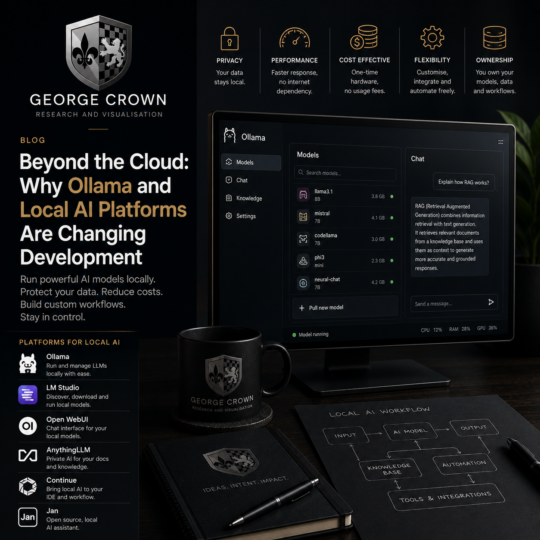
A local AI model runs directly on your own hardware rather than relying on a third-party cloud provider.
These models can operate on:
- Desktop workstations
- Laptops
- Home servers
- Enterprise infrastructure
- Dedicated AI hardware
Popular examples include open-weight large language models, vision models, coding assistants, speech recognition systems, and image generation tools.
Instead of sending information to a remote service, processing occurs entirely within your own environment.
The result is greater control over performance, security, privacy, and integration.
Why Local AI Matters
Cloud AI is incredibly powerful, but it introduces dependencies.
Your workflow relies on:
- Internet connectivity
- External providers
- Usage limits
- Subscription costs
- Data policies
- Service availability
Local AI changes the equation.
Privacy First
Sensitive documents remain within your own systems.
Client information, intellectual property, research material, and internal communications never need to leave your infrastructure.
For architects, designers, researchers, and businesses handling confidential information, this can be a significant advantage.
Greater Control
Local models can be customised and fine-tuned to suit specific requirements.
Instead of adapting your workflow to the AI, the AI can be adapted to your workflow.
Predictable Costs
Cloud-based AI often scales with usage.
Local systems require hardware investment, but once deployed, usage costs become far more predictable.
Independence
A local workflow continues functioning even when external services experience outages, restrictions, or policy changes.
Control remains with the user.
The Rise of AI Workflows
Running a model locally is only the beginning.
The real power emerges when models become part of an automated workflow.
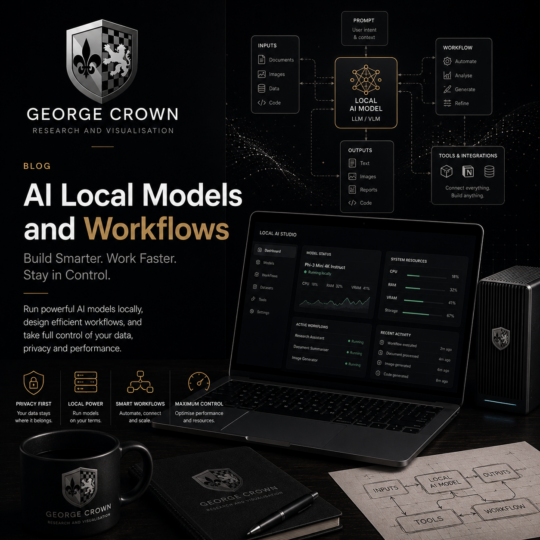
Think of AI not as a single tool but as an interconnected system.
A workflow might:
- Receive a project brief
- Analyse requirements
- Gather research
- Generate concepts
- Create visualisations
- Produce documentation
- Organise assets
- Deliver outputs
Each step can involve different models working together.
The result is a coordinated pipeline rather than a standalone application.
From Individual Tools to Intelligent Systems
Many people start with a chatbot.
Eventually they realise the opportunity is much larger.
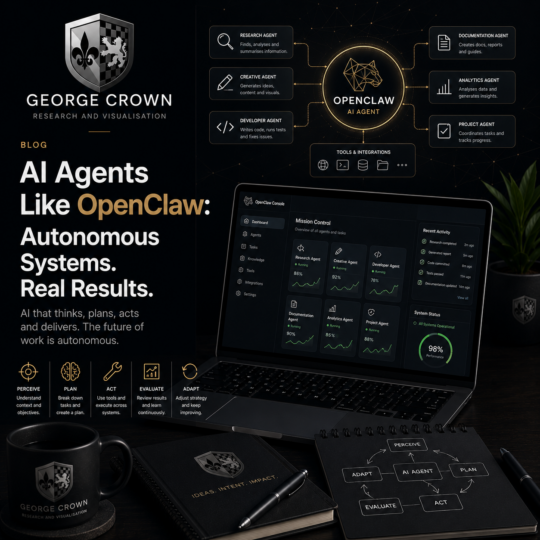
Instead of asking a single AI to perform every task, specialised systems can collaborate.
For example:
Research Workflow
A language model analyses reports, extracts insights, summarises findings, and organises information into structured knowledge.
Design Workflow
Visual AI generates concepts, evaluates variations, and creates presentation assets.
Development Workflow
Coding models generate software, review implementations, identify issues, and document solutions.
Content Workflow
Writing agents draft articles, create metadata, optimise SEO, and prepare publication assets.
Each component contributes to a larger objective.
Building a Personal AI Studio
Modern local AI ecosystems allow individuals to create what was once only available to large organisations.
A personal AI studio might include:
- Local language models
- Vision models
- Image generation tools
- Voice systems
- Workflow automation platforms
- Knowledge databases
- Custom agents
Together they form a digital environment capable of supporting research, visualisation, development, and decision-making.
This approach transforms AI from a simple assistant into an operational system.
Research and Visualisation
At George Crown, research and visualisation sit at the centre of every successful project.
Local AI enhances both.
Research becomes faster because information can be processed, analysed, categorised, and retrieved more efficiently.
Visualisation becomes more powerful because concepts can move rapidly from idea to representation.
Whether creating architectural studies, technical documentation, software concepts, strategic plans, or creative projects, local AI systems provide a framework for exploring possibilities with unprecedented speed.
The combination of intelligent workflows and visual thinking creates a powerful environment for innovation.
Challenges and Considerations
Local AI is not without challenges.
Successful deployment requires consideration of:
- Hardware requirements
- Storage capacity
- Model selection
- Workflow design
- Security practices
- Ongoing maintenance
The objective should not be to replace every cloud service.
Instead, it is about understanding which tasks benefit from local execution and designing systems accordingly.
The strongest solutions often combine local and cloud resources strategically.
The Future of AI Workflows
The next generation of AI will be defined less by individual models and more by interconnected systems.
Research agents.
Coding agents.
Visualisation agents.
Knowledge agents.
Automation agents.
These specialised tools will increasingly work together to solve complex problems.
The question will no longer be:
“What can this AI model do?”
Instead it will become:
“What can this workflow achieve?”
Final Thoughts
Artificial intelligence is rapidly evolving from a tool into infrastructure.
Local models provide privacy, flexibility, and control.
Workflows provide scale, consistency, and automation.
Together they create intelligent systems capable of transforming how we research, design, build, and communicate.
The future belongs not simply to those with access to AI.
It belongs to those who can orchestrate AI effectively.
Local models give you ownership.
Workflows give you leverage.
Combined, they create a foundation for a more capable, independent, and intelligent way of working.